

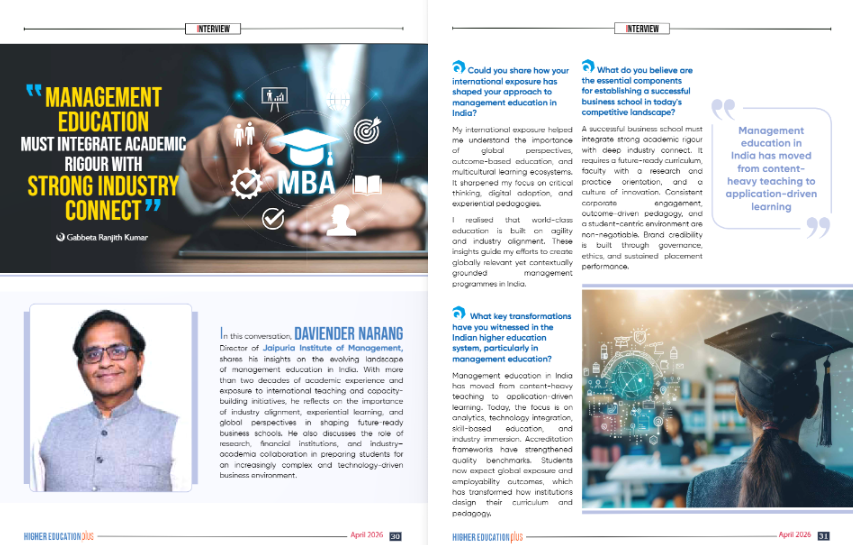
In this conversation, DAVIENDER NARANG, Director of Jaipuria Institute of Management, shares his insights on the evolving landscape of management education in India. With more than two decades of academic experience and exposure to international teaching and capacity-building initiatives, he reflects on the importance of industry alignment, experiential learning, and global perspectives in shaping future-ready business schools. He also discusses the role of research, financial institutions, and industry-academia collaboration in preparing students for an increasingly complex and technology-driven business environment.
INTERVIEW
Could you share how your international exposure has shaped your approach to management education in India?
My international exposure helped me understand the importance of global perspectives, outcome-based education, and multicultural learning ecosystems. It sharpened my focus on critical thinking, digital adoption, and experiential pedagogies.
I realised that world-class education is built on agility and industry alignment. These insights guide my efforts to create globally relevant yet contextually grounded management programmes in India.
What key transformations have you witnessed in the Indian higher education system, particularly in management education?
Management education in India has moved from content-heavy teaching to application-driven learning. Today, the focus is on analytics, technology integration, skill-based education, and industry immersion. Accreditation frameworks have strengthened quality benchmarks. Students now expect global exposure and employability outcomes, which has transformed how institutions design their curriculum and pedagogy.
What do you believe are the essential components for establishing a successful business school in today’s competitive landscape?
A successful business school must integrate strong academic rigour with deep industry connect. It requires a future-ready curriculum, faculty with a research and practice orientation, and a culture of innovation. Consistent corporate engagement, outcome-driven pedagogy, and a student-centric environment are non-negotiable. Brand credibility is built through governance, ethics, and sustained placement performance.
How do you see the role of financial institutions evolving in the coming years, and what impact will that have on management education?
Financial institutions are shifting towards digital-first models, data-driven decision-making, and customer-centric innovation. With rising fintech integration, banks are redefining efficiency and risk frameworks. This demands graduates who understand analytics, regulatory compliance, and digital finance. Management education must therefore embed these competencies to prepare students for the evolving financial ecosystem.
Could you explain how your dual postgraduate degrees in Business Economics and Finance & Control contribute to your teaching and research? How do these disciplines intersect in your curriculum?
Business Economics gives me a macro understanding of markets, policy, and economic behaviour, while Finance & Control brings depth in financial systems, valuation, and corporate decision-making. Together, they enable an integrated approach to teaching and research. Students benefit from a curriculum that connects economic logic with financial strategy, creating stronger analytical foundations.
You have worked on capacity-building initiatives in Ethiopia. What was your experience in applying management principles in a developing economy, and what lessons did you take from that project?
Working in Ethiopia taught me how management principles must adapt to local socio-economic realities. Resource constraints demand innovative, context-specific solutions. Capacity-building there strengthened my belief in experiential learning, leadership development, and institution-level capability enhancement. It reinforced the idea that management education must be inclusive, scalable, and sensitive to developmental challenges.
How important is industry-academia collaboration in shaping the future of management education, and what steps can institutes take to strengthen these ties?
Industry-academia collaboration is central to ensuring curriculum relevance, employability, and innovation. Institutes must actively co-create courses, invite practitioners as co-faculty, and embed live projects and internships into the programme. Regular corporate advisory boards, faculty immersion programmes, and sector-specific centres of excellence can significantly strengthen these partnerships.
How do you integrate real-world financial scenarios into the classroom to bridge the gap between theory and practice?
I use live market data, company financial statements, and industry cases to help students connect theory with actual decision-making. Simulators, portfolio-building exercises, and analysis of real mutual fund performance deepen practical understanding. This hands-on approach develops financial intuition and prepares students for corporate challenges from day one.
How can students and faculty improve their research skills to contribute more effectively to the field of management?
High-impact research begins with identifying contemporary, industry-relevant problems that truly require solutions. Students and faculty must focus on such real-world issues and apply disciplined research design, advanced analytical tools, and evidence-based methods. Regular engagement with top journals, industry data, and research forums strengthens their perspective. At our institute, we reinforce this culture through continuous Faculty Development Programmes, mentoring, and structured research support, ensuring that both students and faculty produce meaningful and industry-beneficial contributions.
What do you believe are the biggest challenges faced by business leaders today, and how can management education programmes be tailored to address these challenges?
Business leaders today face volatility, digital disruption, talent retention challenges, and ethical dilemmas. Management education must equip learners with agility, emotional intelligence, data literacy, and strategic problem-solving skills. A blend of experiential learning, leadership labs, and real-world projects can prepare students to navigate these complex challenges effectively.
Published by