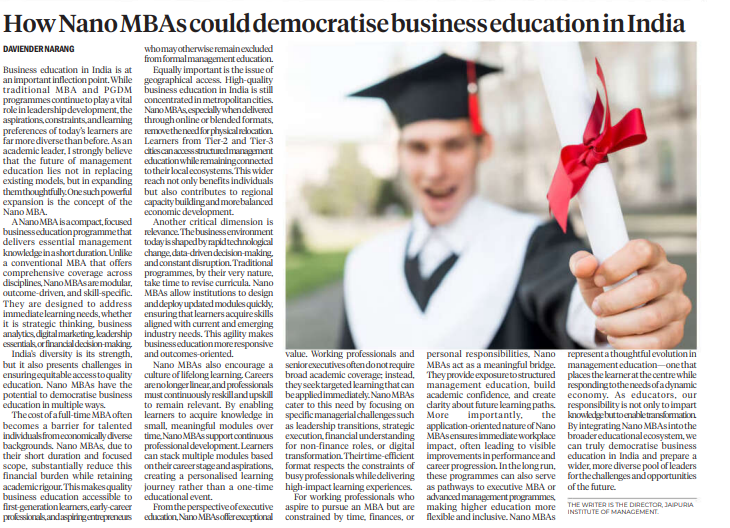
Business education in India has traditionally been associated with full-time MBA and PGDM programs offered by leading institutions. While these programs play a crucial role in leadership development and managerial training, they often remain inaccessible to many aspirants due to financial, geographic, and time constraints. In this evolving context, Nano MBAs are emerging as a powerful alternative that has the potential to democratise business education across the country.
The Rise of Nano MBAs in a Changing Education Landscape
Nano MBAs are short, focused learning programs designed to deliver essential management knowledge in a flexible and modular format. Unlike traditional MBA programs that require long-term commitment, Nano MBAs allow learners to upskill quickly and efficiently. They focus on practical competencies rather than exhaustive theoretical coverage, making them highly relevant in a fast-changing business environment.
These programs are particularly effective in addressing the needs of
- Working professionals seeking career advancement
- Entrepreneurs and startup founders
- Learners from Tier 2 and Tier 3 cities
- Professionals looking to reskill without career breaks
Improving Access and Affordability
One of the most significant contributions of Nano MBAs lies in improving access to quality business education. Traditional management programs often involve high tuition fees and relocation costs. Nano MBAs, especially those delivered through online or blended formats, significantly reduce these barriers.
By lowering financial and geographic constraints, Nano MBAs open doors for a wider pool of learners who were previously excluded from formal management education. This inclusivity strengthens the overall talent ecosystem and supports regional economic development.
Industry Relevant and Skill Focused Learning
Nano MBAs are designed to align closely with industry needs. Instead of lengthy curriculum cycles, these programs can be updated quickly to reflect emerging trends such as
- Data driven decision making
- Digital transformation
- Artificial Intelligence in business
- Financial analytics
- Leadership and people management
This agility ensures that learners acquire skills that are immediately applicable in the workplace. For employers, this translates into a workforce that is better prepared to handle contemporary business challenges.
Supporting Lifelong Learning and Career Mobility
In today’s dynamic job market, learning is no longer a one-time event. Nano MBAs support the idea of lifelong learning by allowing professionals to continuously upgrade their skills. Learners can pursue multiple Nano MBA modules over time, building expertise across domains and enhancing career mobility.
For professionals constrained by time and responsibilities, Nano MBAs provide a structured yet flexible pathway to growth without disrupting existing careers.
Complementing Traditional Management Education
Nano MBAs are not a replacement for full-time MBA programs. Instead, they complement traditional management education by expanding its reach and relevance. While comprehensive MBA programs continue to develop deep leadership capabilities, Nano MBAs address immediate skill gaps and evolving industry demands.
Together, these formats create a more inclusive and responsive business education ecosystem.
The Way Forward for Indian Business Education
As India moves towards a knowledge driven and innovation led economy, education models must evolve to match the pace of change. Nano MBAs represent a meaningful step toward inclusive, flexible, and industry aligned learning. By embracing such models, institutions can empower a diverse group of learners and contribute to building a future ready workforce.
For management institutions, integrating Nano MBAs into the broader education ecosystem reflects a commitment to accessibility, innovation, and lifelong learning.
Published by