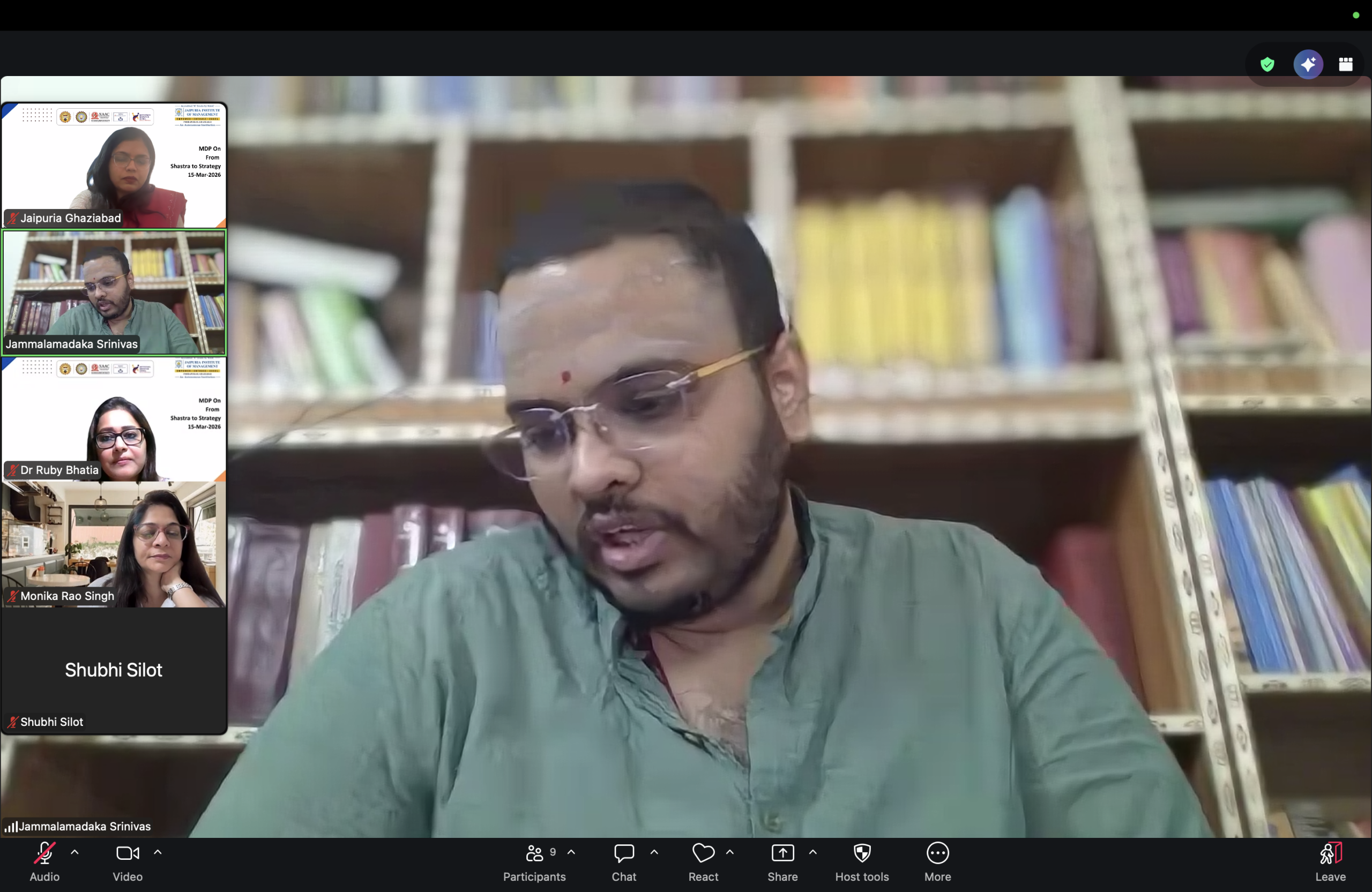
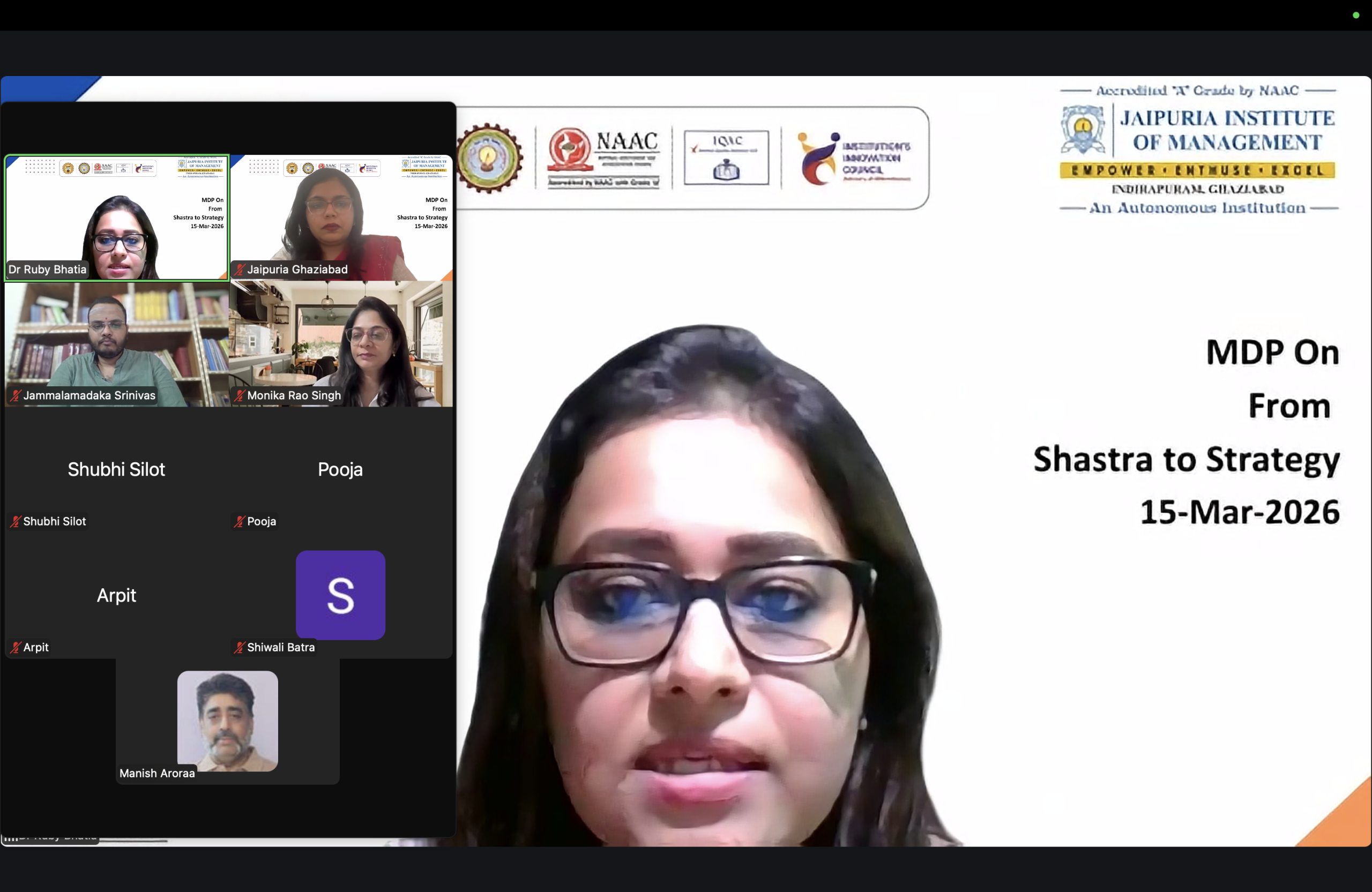
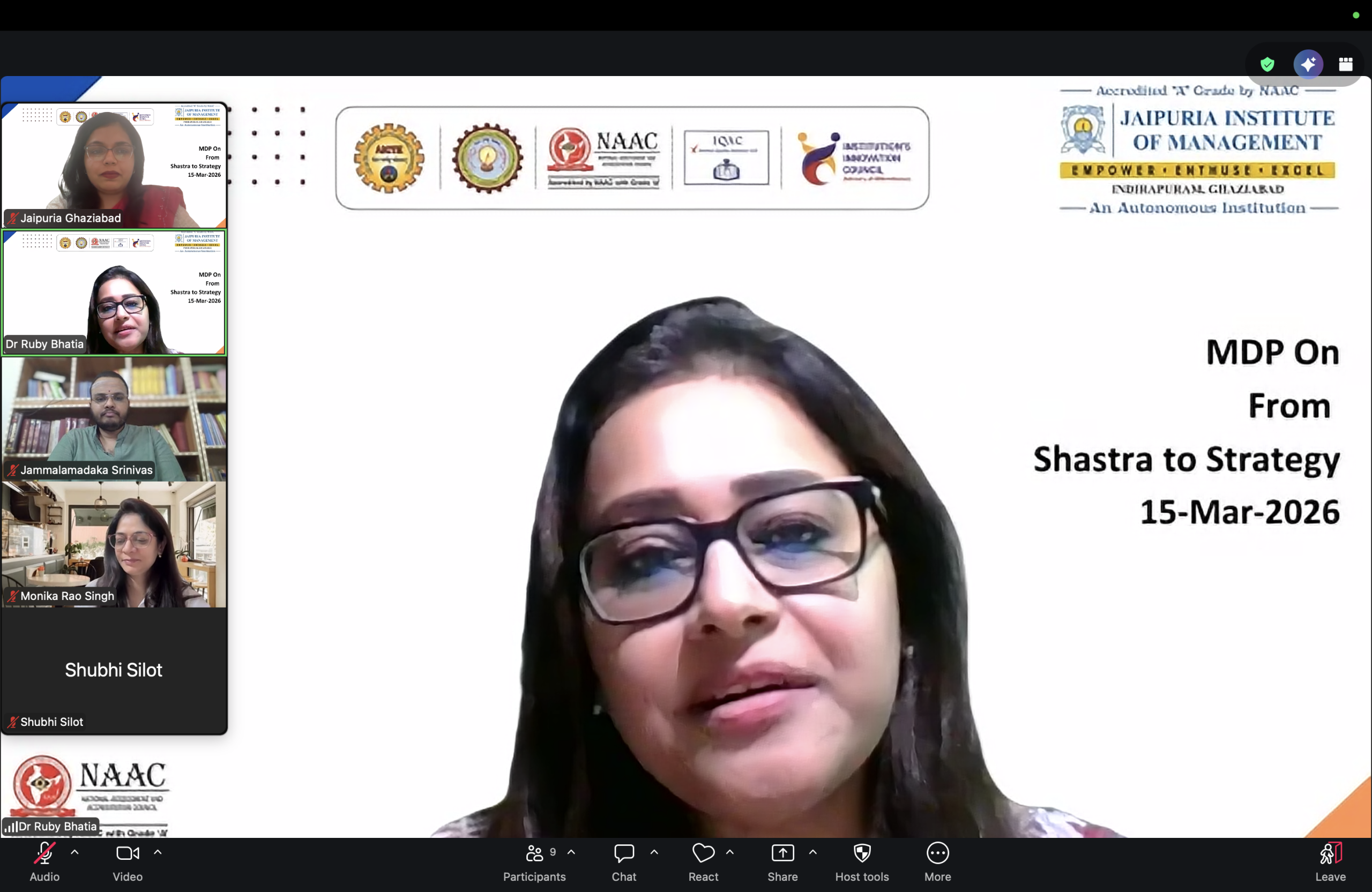
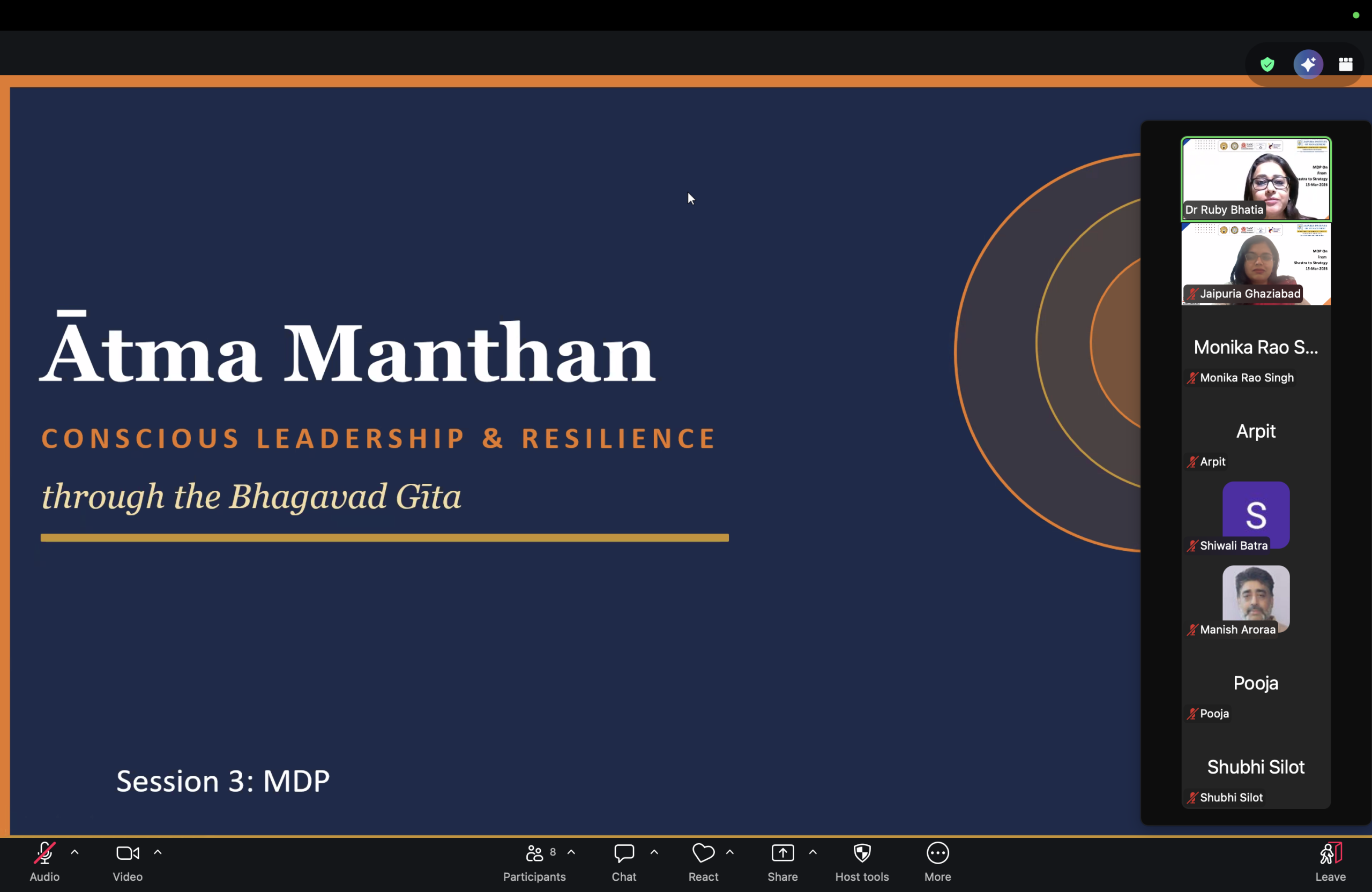
In today’s fast-paced and ever-evolving business environment, leadership is being redefined by ethical decision-making, resilience, and the integration of modern wisdom with traditional knowledge. With this in mind, Jaipuria Institute of Management Ghaziabad hosted a Management Development Programme (MDP) titled “From Shastra to Strategy: Translating Indian Knowledge Systems into Contemporary Leadership and Business Decision-Making” on 15 March 2026.
Held online from 10:00 a.m. to 3:00 p.m., the programme brought together 7 industry professionals from diverse fields to explore the deep-rooted leadership wisdom embedded in ancient Indian texts and how they can be applied to modern business challenges, including leadership in the age of Artificial Intelligence.
The programme was guided by Dr. Srinivas Jammakalada, Dr. Ruby Bhatia, and Ms. Smriti Dixit, who used interactive and experiential learning methods to help participants integrate the principles of Nītiśāstra, Arthaśāstra, Nītisāra, and the Bhagavad Gītā into contemporary managerial practice.
Objective of the Programme
The core objective of the programme was to enable industry professionals to understand and apply leadership insights drawn from ancient Indian knowledge systems (IKS) and translate them into modern business strategies and leadership practices. The specific objectives were to:
- Equip participants with the understanding of Indian Knowledge Systems (Nītiśāstra, Arthaśāstra, Nītisāra, Bhagavad Gītā) and their contemporary relevance.
- Introduce Yathartha Viveka and Neetipoorna Aacharan as tools for ethical decision-making and leadership under pressure.
- Develop emotional balance, resilience, and reflective habits (Sthitaprajñā, Ātma Manthan) for sustainable leadership and well-being.
- Provide practical governance, accountability, and people practices aligned with IKS principles.
- Inspire values-driven leadership and decision-making that integrates traditional wisdom with modern business challenges.
By the end of the programme, participants were equipped to apply these ancient principles to modern-day organizational leadership, navigate AI-era challenges, and create value-driven business practices.
Programme Description and Methodology
The MDP was designed to be interactive and experiential rather than a traditional lecture-based format. The resource persons guided participants through contemporary leadership dilemmas, short case studies, and AI-era scenarios in small groups. Participants applied insights from Indian Knowledge Systems to analyze options and consequences, making this approach highly relevant for real-world applications.
The 4-step IKS decision lens, reflection exercises, pair-sharing of personal dilemmas, and guided discussions helped participants connect ancient wisdom to their current organizational contexts. This hands-on methodology ensured that the learning experience was practical and could be immediately applied in professional settings.
Program Outline and Key Sessions
The programme was structured into three distinct yet interconnected sessions, each focusing on different aspects of leadership based on Indian Knowledge Systems.
Session 1: Neetisara and Arthaśāstra – Ancient Wisdom in Contemporary Governance
The first session was led by Dr. Srinivas Jammakalada, who explored the contemporary relevance of Neetisara and Arthaśāstra. Dr. Jammakalada illustrated how ancient strategic wisdom can guide present-day leadership and governance. Key aspects of this session included:
- Governance principles and ethics from Arthaśāstra that inform modern managerial decision-making.
- Strategic thinking and leadership practices from Nītisāra that remain applicable to modern corporate contexts.
- Real-world applications of ancient texts for ethical leadership and organizational governance.
This session emphasized how understanding ancient principles can help leaders navigate today’s complex corporate environments and drive ethical, strategic decisions.
Session 2: Yathartha Viveka and Neetipoorna Aacharan – Wisdom-Based Decision Making
The second session, conducted by Ms. Smriti Dixit, focused on the principles of Yathartha Viveka (practical wisdom) and Neetipoorna Aacharan (ethical conduct). The session was particularly relevant for leaders in the age of Artificial Intelligence and data-driven decision-making. Key takeaways from the session included:
- Balancing performance pressures with ethical responsibility.
- Applying wisdom-based decision-making to real-world corporate challenges.
- Leadership strategies that integrate wisdom and ethical conduct into daily operations.
Ms. Dixit emphasized that modern leaders can benefit greatly from combining traditional wisdom with current technological tools, ensuring ethical and strategic decision-making.
Session 3: Bhagavad Gita – Leadership, Resilience, and Personal Development
In the final session, Dr. Ruby Bhatia presented the timeless teachings of the Bhagavad Gita and their relevance to leadership and personal development. Drawing from selected leadership shlokas, Dr. Bhatia highlighted concepts of Sthitaprajñā (steadfast wisdom) and Ātma Manthan (self-reflection). The session focused on:
- Building emotional resilience and maintaining balance in leadership.
- The importance of self-reflection and mindfulness in decision-making.
- Applying the Gita’s teachings on values-driven leadership in personal and professional growth.
Dr. Bhatia emphasized how emotional balance and mindfulness, rooted in the Bhagavad Gita, can help leaders navigate stress, handle uncertainty, and maintain ethical leadership practices.
Learning Outcomes for Participants
The MDP provided valuable insights for the participants, who were able to:
- Translate insights from Indian Knowledge Systems into modern leadership and business practices.
- Understand how ancient texts can inform ethical decision-making and governance.
- Develop resilience, emotional intelligence, and reflective habits for sustainable leadership.
- Apply wisdom from the Bhagavad Gita and Arthaśāstra to real-world business challenges.
- Build values-driven leadership practices that align with both traditional wisdom and modern business demands.
Active Participation and Industry Perspectives
The programme saw 7 industry professionals participate, representing organizations such as HP and Deutsche Bank, as well as leadership coaches. Their diverse backgrounds enriched the discussions, providing practical insights into the application of Indian Knowledge Systems in various organizational contexts.
The active participation of these professionals helped create a dynamic learning environment, where real-world industry challenges were addressed through the lens of ancient wisdom.
Faculty Coordinators and Event Organizers
The programme was expertly coordinated by Dr. Ruby Bhatia, Dr. Kratika Singh, and Dr. Kirti Singh, who played key roles in organizing and facilitating the session. Their leadership ensured the smooth execution of the event and fostered an environment of engagement and learning.
The Management Development Programme on “From Shastra to Strategy” successfully bridged the gap between ancient Indian knowledge systems and contemporary leadership practices. The session empowered participants with practical insights on integrating wisdom from Nītiśāstra, Arthaśāstra, Nītisāra, and the Bhagavad Gītā into modern business environments.
The programme was a step forward in creating values-driven leadership, promoting ethical decision-making, and preparing leaders for the challenges of the AI era.
Jaipuria Institute of Management Ghaziabad remains committed to providing high-impact learning experiences that combine traditional wisdom with contemporary business practices, empowering leaders to navigate complex organizational landscapes with resilience and ethical clarity.