
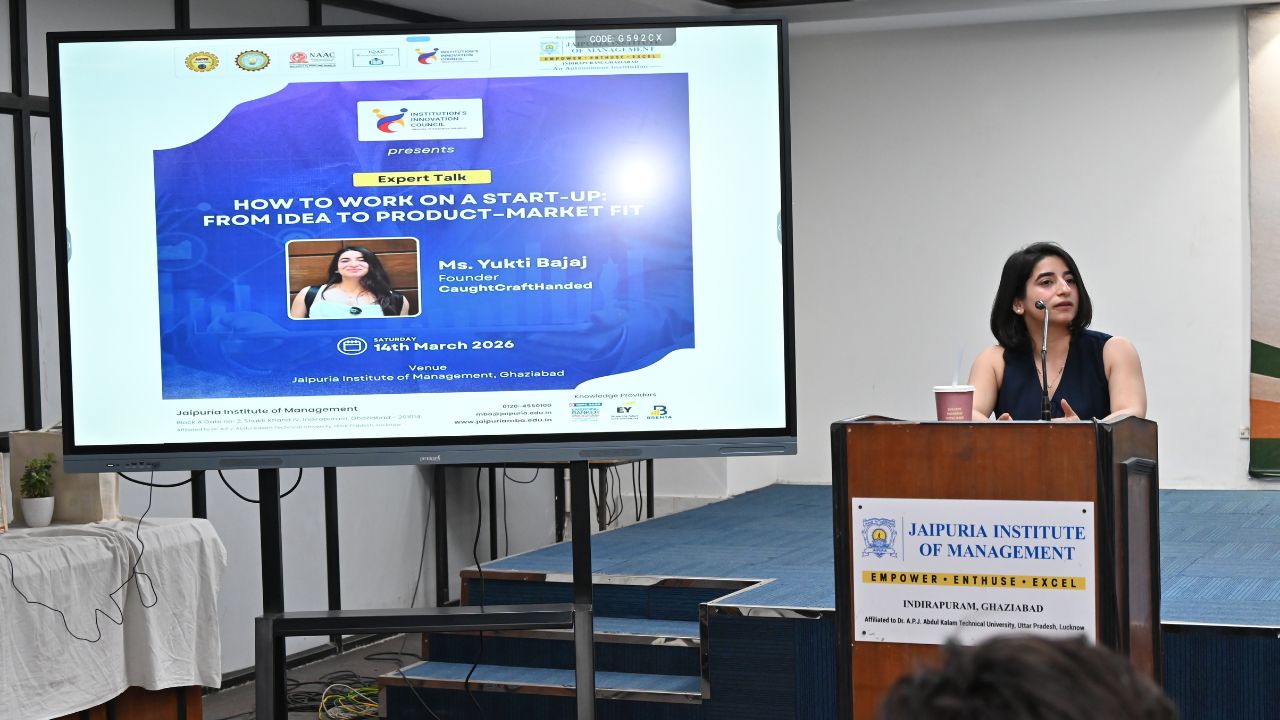
Entrepreneurship today plays a crucial role in shaping economic growth, innovation, and job creation. For management students, understanding how ideas evolve into successful businesses is an essential part of developing an entrepreneurial mindset. With this objective, the Institution Innovation Council (IIC) of Jaipuria Institute of Management Ghaziabad organized an expert talk titled How to Work on a Start-up: From Idea to Product Market Fit.
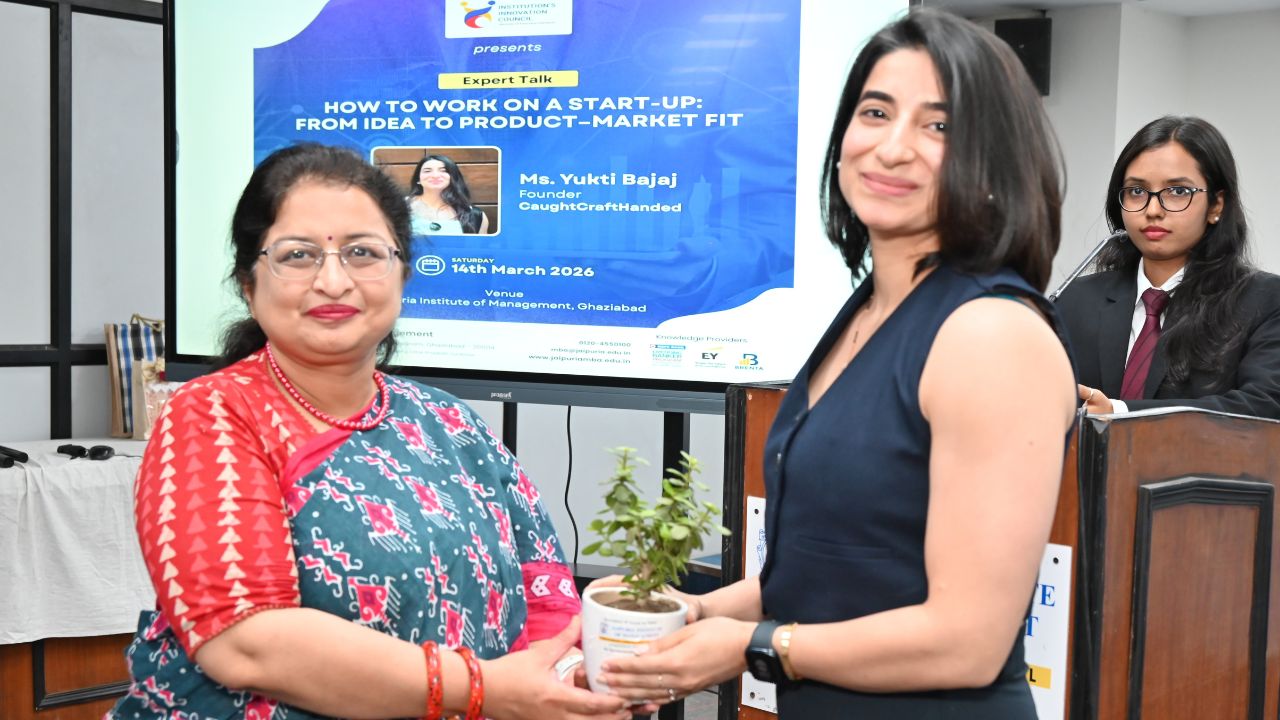
The session was conducted on 14 March 2026 at the JIM Auditorium and brought together MBA students interested in innovation, entrepreneurship, and start-up development. The expert speaker for the session was Ms. Yukti Bajaj, Founder of CaughtCraftHanded, who shared valuable insights from her entrepreneurial journey and practical experience in building a purpose driven start-up.
The session was coordinated by faculty members Dr. Devi Archana Mohanty, Dr. Namita Nigam, and Dr. Smita Agrawal, who guided the initiative as part of the institute’s efforts to promote innovation and entrepreneurial thinking among students.
Objective of the Expert Talk
The expert talk was designed to provide MBA students with a deeper understanding of how start-ups are conceptualized, developed, and brought to market. While many students are familiar with the idea of entrepreneurship, the session aimed to explain the real process involved in transforming an innovative idea into a viable business.
The key objectives of the session included:
- Providing practical exposure to the start-up development process from ideation to market validation.
- Helping students understand the entrepreneurial mindset required to identify opportunities and solve real world problems.
- Introducing the concept of product market fit and why it is critical for start-up success.
- Explaining validation techniques and strategies used to convert innovative ideas into sustainable business models.
- Encouraging students to think creatively and explore entrepreneurship as a potential career path.
- The session aimed to bridge the gap between theoretical understanding of entrepreneurship and real world start-up practices.
Insights from Entrepreneur Yukti Bajaj
The session began with an introduction to the fundamentals of start-up development and entrepreneurial thinking. Ms. Yukti Bajaj, founder of the start-up CaughtCraftHanded, shared her inspiring journey of launching a venture during the challenging period of the lockdown.
She explained how successful start-ups often begin with a simple observation of everyday problems. According to her, the foundation of entrepreneurship lies in identifying genuine problems faced by people and designing solutions that create meaningful value.
During the discussion, she shared how her entrepreneurial initiative focused on creating employment opportunities for senior citizens, demonstrating how business ideas can combine innovation with social impact.
Her journey highlighted the importance of resilience, creativity, and a strong purpose in building a sustainable venture.
Understanding the Start-up Journey
A key part of the session focused on explaining the different stages that entrepreneurs typically go through when building a start-up.
Ms. Bajaj explained the structured journey of start-up development, which includes several important stages:
Idea generation and opportunity identification
Entrepreneurs begin by identifying problems or gaps in the market and generating ideas that address these challenges.
Problem validation
Before building a product, it is important to validate whether the problem actually exists and whether customers are willing to pay for a solution.
Building a Minimum Viable Product (MVP)
An MVP is a simple version of the product that allows entrepreneurs to test the concept with real users without investing large resources.
Customer discovery and feedback
Start-ups must engage with early users and gather feedback to understand how the product can be improved.
Achieving Product Market Fit
This stage occurs when the product successfully addresses a real customer need and begins generating consistent demand.
Students were encouraged to think of start-up development as a continuous process of experimentation and learning rather than a fixed path.
Importance of Product Market Fit
One of the most important concepts discussed during the session was Product Market Fit. Ms. Bajaj emphasized that many start-ups fail not because they lack innovation, but because they fail to solve a real problem for customers.
Product Market Fit occurs when a product successfully meets the needs of a specific group of customers and creates sustained demand in the market.
The session explained that entrepreneurs must focus on understanding their customers deeply before investing heavily in product development. By testing ideas early and validating assumptions, start-ups can significantly increase their chances of success.
This perspective helped students understand that entrepreneurship requires careful validation and market understanding, not just creativity.
Learning Through the Build Measure Learn Approach
Another important concept introduced during the session was the Build Measure Learn framework, which is widely used in start-up ecosystems.
This approach encourages entrepreneurs to:
Build a basic prototype or MVP of their idea.
Measure user responses and gather feedback.
Learn from the feedback and refine the product accordingly.
By following this iterative cycle, entrepreneurs can continuously improve their products and align them more closely with customer expectations.
Students were encouraged to adopt this experimental mindset while developing their own start-up ideas.
Entrepreneurial Mindset and Leadership Traits
The expert talk also focused on the personal qualities that are essential for entrepreneurs. Building a start-up often involves uncertainty, experimentation, and repeated learning.
According to Ms. Bajaj, successful entrepreneurs demonstrate key traits such as:
Resilience in facing challenges and setbacks.
Adaptability to changing market conditions.
Continuous experimentation and willingness to learn.
Strong problem solving skills.
Empathy for customer needs.
These qualities enable entrepreneurs to navigate the uncertainties of start-up development and transform ideas into sustainable ventures.
Student Participation and Engagement
The session witnessed enthusiastic participation from 75 MBA students, who actively engaged with the speaker through questions, discussions, and reflections on entrepreneurial challenges.
Students showed particular interest in understanding how start-ups identify real problems, validate ideas, and secure early customers. Many also expressed curiosity about funding, scaling strategies, and the role of innovation in building competitive businesses.
The interactive nature of the session allowed students to connect classroom learning with real entrepreneurial experiences.
Encouraging Innovation and Entrepreneurship at Jaipuria Institute of Management Ghaziabad
Events such as the IIC Expert Talk reflect the commitment of Jaipuria Institute of Management Ghaziabad to promoting innovation, creativity, and entrepreneurial thinking among students.
Through the activities of the Institution Innovation Council, the institute regularly organizes expert talks, workshops, industry interactions, and entrepreneurship development initiatives.
These activities encourage students to explore innovative ideas, understand the start-up ecosystem, and develop the confidence required to pursue entrepreneurial ventures.
By bringing entrepreneurs and industry experts into the academic environment, the institute ensures that students gain exposure to real world business challenges and opportunities.
The IIC Expert Talk on How to Work on a Start-up: From Idea to Product Market Fit proved to be an insightful learning experience for MBA students at Jaipuria Institute of Management Ghaziabad.
The session helped students understand the practical journey of building a start-up, from identifying problems to achieving product market fit. It also highlighted the importance of validation, experimentation, and customer understanding in entrepreneurial success.
The discussion encouraged students to think beyond traditional career paths and consider entrepreneurship as a powerful avenue for innovation and impact.
The report for the session was prepared by Dr. Devi Archana Mohanty, who also served as one of the faculty coordinators for the event.