Financial literacy has become an essential skill in today’s evolving economic and business environment. Understanding concepts such as savings, investments, financial planning, and risk management is no longer limited to finance professionals alone. It has become a critical competency for future managers and decision-makers across industries. Recognizing this importance, Jaipuria Institute of Management, Ghaziabad continues to focus on strengthening conceptual learning, analytical thinking, and industry-oriented education among students.
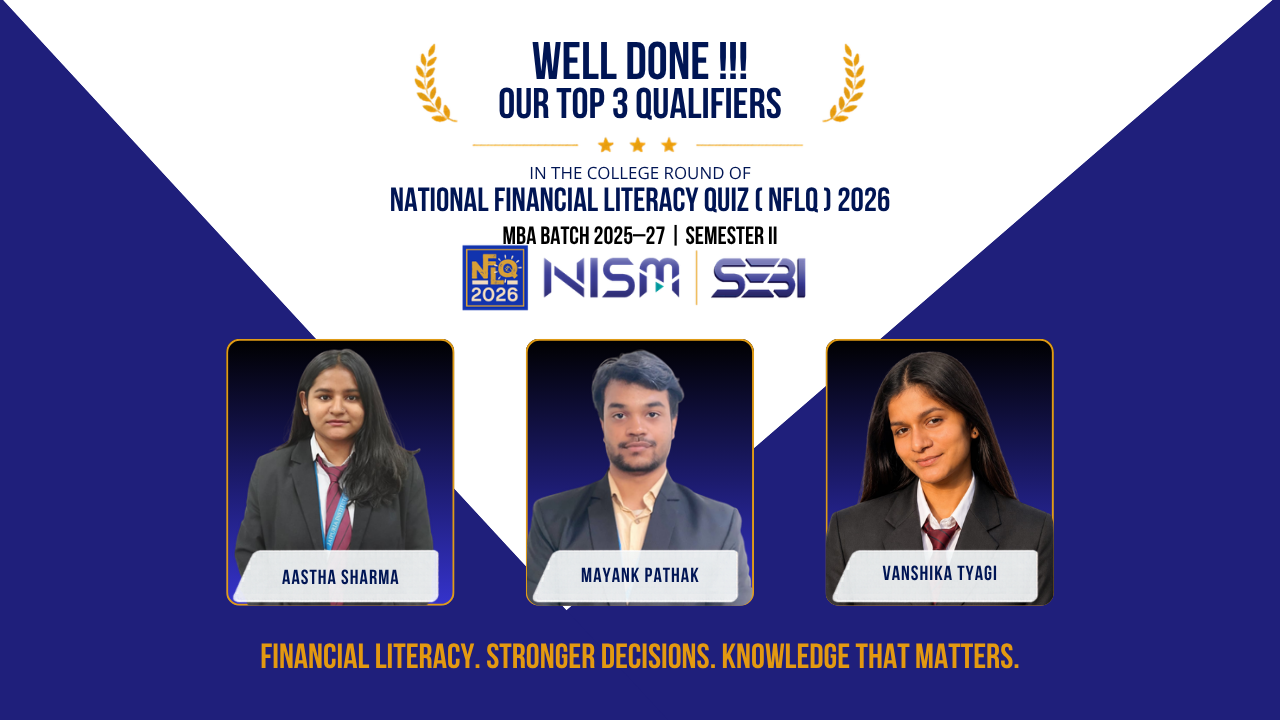
Reflecting this academic approach, Astha Sharma, Mayank Pathak, and Vanshika Tyagi from the MBA Batch 2025–27 (Semester II) secured the highest scores in the college round of the National Financial Literacy Quiz (NFLQ) 2026 conducted by National Institute of Securities Markets in association with Securities and Exchange Board of India.
Their achievement highlights strong conceptual understanding, financial awareness, and the ability to apply knowledge effectively in competitive academic environments. It also reflects the institute’s continued emphasis on preparing students for real-world challenges through practical learning and industry exposure.
Understanding the Importance of NFLQ
The National Financial Literacy Quiz (NFLQ) is an initiative aimed at promoting financial awareness among students across India. Conducted by the National Institute of Securities Markets (NISM), the quiz encourages participants to strengthen their understanding of important financial concepts such as investments, savings, banking systems, insurance, financial planning, and risk management.
As financial systems continue to evolve rapidly, awareness about personal finance and economic decision-making has become increasingly important for students pursuing management education. Initiatives like NFLQ provide students with opportunities to assess their understanding of financial concepts while improving their analytical and problem-solving abilities.
The quiz also encourages students to stay informed about financial markets, economic systems, and responsible financial practices. Participation in such national-level competitions allows students to move beyond theoretical learning and engage with concepts that are directly relevant to industry and business environments.
Building Strong Conceptual Foundations
At Jaipuria Institute of Management, Ghaziabad, management education focuses on more than classroom instruction alone. The institute encourages students to develop strong conceptual clarity, practical understanding, and critical thinking abilities that can be applied effectively in professional settings.
The performance of Astha Sharma, Mayank Pathak, and Vanshika Tyagi in NFLQ 2026 reflects this emphasis on concept-driven learning. Their achievement demonstrates not only academic preparation but also the ability to understand and analyze financial concepts with confidence and clarity.
Management students today are expected to understand business dynamics, evaluate risks, interpret market trends, and make informed decisions. Financial literacy plays a significant role in building these capabilities. Whether students pursue careers in finance, marketing, consulting, analytics, operations, or entrepreneurship, understanding financial systems remains an important part of managerial effectiveness.
The institute’s academic environment supports this development by encouraging students to participate in competitions, workshops, certifications, industry interactions, and practical learning activities that strengthen both knowledge and professional readiness.
Industry-Oriented Learning and Student Development
Jaipuria Institute of Management, Ghaziabad consistently works towards aligning academic learning with evolving industry expectations. The curriculum and student engagement activities are designed to encourage application-based learning and skill development across multiple domains.
Students are regularly exposed to industry interactions, guest lectures, corporate sessions, financial awareness initiatives, management events, and experiential learning opportunities that contribute to their overall professional growth. These activities help students develop analytical ability, communication skills, decision-making capabilities, and business awareness alongside academic knowledge.
Participation in national-level competitions such as NFLQ further enhances this learning experience by allowing students to test their abilities in competitive environments. Such platforms encourage discipline, preparation, confidence, and intellectual curiosity while motivating students to continuously improve their understanding of important business and financial concepts.
The achievement of the Semester II MBA students in NFLQ 2026 reflects the effectiveness of this learning ecosystem and the institute’s commitment to developing future-ready management professionals.
Financial Literacy and Future Management Professionals
Financial literacy is increasingly becoming a core requirement for effective leadership and business decision-making. In modern business environments, managers across industries are expected to understand financial implications, evaluate opportunities, manage risks, and contribute to strategic growth.
Knowledge related to budgeting, investments, market systems, financial planning, and economic trends supports better managerial thinking and informed decision-making. Financial awareness also helps professionals understand organizational performance and market dynamics more effectively.
For management students, exposure to financial literacy initiatives strengthens confidence and prepares them for complex business situations. It encourages logical thinking, structured analysis, and responsible decision-making, all of which are essential qualities for future leaders.
The achievement of Astha Sharma, Mayank Pathak, and Vanshika Tyagi demonstrates how continuous learning and academic engagement can contribute to both personal growth and professional preparedness.
Encouraging Academic Excellence Beyond the Classroom
Academic competitions provide students with valuable opportunities to challenge themselves beyond traditional classroom learning. They encourage students to apply theoretical concepts, strengthen preparation strategies, and develop confidence under competitive conditions.
At Jaipuria Institute of Management, Ghaziabad, students are encouraged to actively participate in national-level competitions and knowledge-driven initiatives that contribute to intellectual and professional development. These experiences support continuous learning while also helping students explore areas of interest and specialization.
The success of the students in the NFLQ 2026 college round serves as an example of dedication, consistent preparation, and strong academic focus. It also reinforces the importance of combining conceptual learning with practical understanding to succeed in today’s dynamic business environment.
Looking Ahead
As industries continue to evolve with rapid economic and technological changes, management professionals must develop strong analytical and financial understanding to navigate challenges effectively. Educational institutions therefore play a critical role in preparing students with the knowledge, confidence, and adaptability required in professional environments.
Jaipuria Institute of Management, Ghaziabad remains committed to creating a learning ecosystem that promotes conceptual clarity, industry exposure, practical learning, and professional growth. Through academic initiatives, competitions, and industry-oriented engagement, the institute continues to support students in building capabilities that are relevant to modern business and management careers.
The achievement of Astha Sharma, Mayank Pathak, and Vanshika Tyagi in the National Financial Literacy Quiz (NFLQ) 2026 reflects this commitment towards academic rigor, financial awareness, and future-focused management education.
The institute extends its best wishes to all three students for the upcoming rounds and continued success in their academic and professional journey.