



Sustainability and responsible business practices have become central to modern corporate strategy. Environmental, Social, and Governance considerations now influence investment decisions, regulatory compliance, and long term business competitiveness. Recognizing this shift in the global business landscape, Jaipuria Institute of Management Ghaziabad organized a Management Development Programme titled ESG Leadership in Action: Charting India’s Path to Sustainable Growth and Global Competitiveness.
The programme was conducted on 15 March 2026 in online mode and brought together corporate professionals interested in understanding how ESG principles can be integrated into business strategy and governance frameworks.
With a duration of five hours from 10:00 AM to 3:00 PM, the programme provided participants with practical insights into ESG regulations, sustainability strategies, and responsible business practices relevant to the Indian corporate environment.
Objective of the Programme
The primary objective of the Management Development Programme was to help managers and corporate professionals understand ESG not merely as a compliance requirement but as a strategic framework for long term value creation.
In the evolving global economy, businesses that integrate sustainability, transparency, and responsible governance into their operations are increasingly gaining competitive advantage.
The programme was designed to help participants:
- Develop a foundational understanding of Environmental, Social, and Governance principles.
- Understand how ESG frameworks influence corporate performance and investor confidence.
- Interpret India’s evolving regulatory frameworks related to sustainability and corporate governance.
- Learn practical strategies for implementing ESG practices within organizations.
- Align business practices with India’s sustainability commitments and governance standards.
By addressing these aspects, the programme aimed to bridge the gap between ESG policy mandates and real business implementation.
ESG as a Strategic Business Imperative
The sessions emphasized that ESG should not be viewed only as a reporting obligation or regulatory requirement. Instead, it must be considered a strategic tool that helps organizations strengthen resilience, improve reputation, and attract long term investment.
Participants were introduced to the growing importance of ESG in global capital markets. Investors increasingly evaluate companies based on sustainability practices, ethical governance, and social responsibility.
Organizations that integrate ESG into their operational and strategic decision making are better positioned to manage risks, build stakeholder trust, and create sustainable value.
This perspective helped participants understand how ESG can contribute directly to business performance and global competitiveness.
Understanding ESG Principles in the Indian Business Context
The programme provided a structured overview of ESG principles and how they apply to Indian corporations.
Participants learned how environmental responsibility, social accountability, and corporate governance practices collectively shape sustainable business operations.
Discussions focused on the Indian regulatory landscape, including the role of Business Responsibility and Sustainability Reporting requirements and other compliance frameworks that guide corporate sustainability disclosures.
The sessions also highlighted how ESG performance can influence:
- Access to capital and investment funding
- Cost of financing and investor confidence
- Corporate reputation and stakeholder trust
- Long term organizational resilience
Understanding these connections helped participants recognize why ESG has become a central component of modern corporate strategy.
Managing ESG Risks and Preventing Greenwashing
One of the critical areas covered during the programme was the identification and management of ESG related risks.
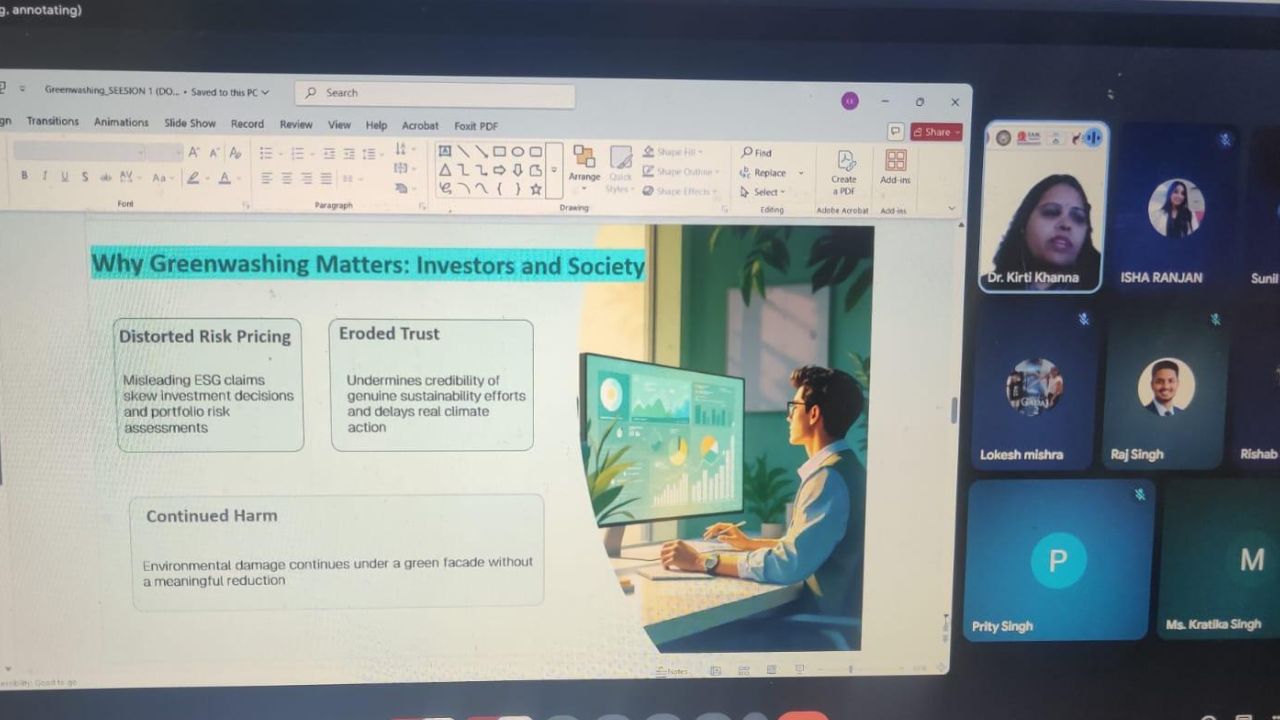
Companies today face increasing scrutiny from regulators, investors, and stakeholders regarding their sustainability commitments. Organizations that fail to implement genuine ESG practices risk facing reputational damage and financial consequences.
Participants were introduced to the concept of greenwashing, where organizations make misleading claims about environmental or sustainability practices without implementing meaningful actions.
The programme explained how businesses can avoid such risks by developing transparent reporting systems and ensuring that ESG initiatives are backed by measurable actions and credible data.
Participants also learned how ESG controversies can create financial risks that affect corporate valuation, investor trust, and regulatory compliance.
Bridging Policy Mandates with Practical Implementation
Another key theme of the programme was the need to translate ESG policies into practical business actions.
While many organizations understand the importance of sustainability frameworks, implementing them effectively across departments remains a challenge.
The programme addressed this issue by guiding participants on how ESG principles can be integrated into various organizational functions.
These include:
- Supply chain management
- Risk management systems
- Corporate governance structures
- Compliance and sustainability reporting
Participants explored how ESG strategies can be embedded into day to day decision making, ensuring alignment between organizational objectives and sustainability commitments.
Building Credible ESG Reporting Practices
Transparency and accountability are essential elements of effective ESG implementation. Companies must ensure that sustainability reporting is accurate, credible, and aligned with regulatory standards.
The programme helped participants understand the difference between genuine ESG action and superficial reporting practices.
Participants were encouraged to develop reporting frameworks that clearly communicate organizational sustainability initiatives while maintaining transparency with investors and stakeholders.
By building credible reporting systems, organizations can strengthen trust and demonstrate their commitment to responsible business practices.
Participation from Corporate Professionals
The programme witnessed participation from seven corporate professionals representing diverse organizations and industries. Their participation created an engaging learning environment where professionals shared experiences and perspectives related to sustainability challenges in their respective sectors.
The participants included representatives from organizations such as:
- Livguard Energy
- Livguard Energy Technology Pvt. Ltd.
- Timex Group
- Livguard Drivetrain
- Spark Minda
- Infoedge India Ltd.
The diverse professional backgrounds of participants enabled valuable discussions on how ESG principles can be applied across different industries and operational contexts.
Academic Leadership and Programme Coordination
The Management Development Programme was conducted with the academic support of faculty members Dr. Kratika Singh and Dr. Kirti Khanna, who contributed their expertise in sustainability and corporate governance.
The event was coordinated by Dr. Ruby Bhatia, Dr. Kratika Singh, and Dr. Kirti Singh, ensuring the smooth organization of the programme and effective engagement with participants.
The report for the programme was prepared by Dr. Kratika Singh.
Strengthening Industry Engagement and Sustainability Leadership
Management Development Programmes play an important role in enhancing the capabilities of professionals and helping organizations adapt to emerging global challenges.
Through initiatives such as this ESG leadership programme, Jaipuria Institute of Management Ghaziabad continues to support industry professionals in understanding critical developments in sustainability, governance, and responsible business practices.
Such programmes create opportunities for knowledge exchange between academia and industry while preparing business leaders to address complex challenges related to environmental responsibility, social impact, and ethical governance.
The Management Development Programme titled ESG Leadership in Action: Charting India’s Path to Sustainable Growth and Global Competitiveness provided participants with a comprehensive understanding of ESG principles and their practical implementation in business environments.
The sessions emphasized that ESG is no longer a peripheral concern but a central driver of long term competitiveness and sustainable growth. By equipping participants with knowledge of regulatory frameworks, risk management strategies, and sustainability reporting practices, the programme helped professionals strengthen their ability to lead responsible and future ready organizations.
The initiative reflects the commitment of Jaipuria Institute of Management Ghaziabad to advancing responsible leadership, sustainability awareness, and industry focused executive education.